
Member Services
Make programme delivery easier to follow from intake to outcome.
RiGEL helps Indigenous Nations connect programme applications, eligibility, review, decisions, records, and follow-up in one governed operational environment. Each programme can reflect its own requirements while sharing common infrastructure for authority, workflow, records, and accountability.
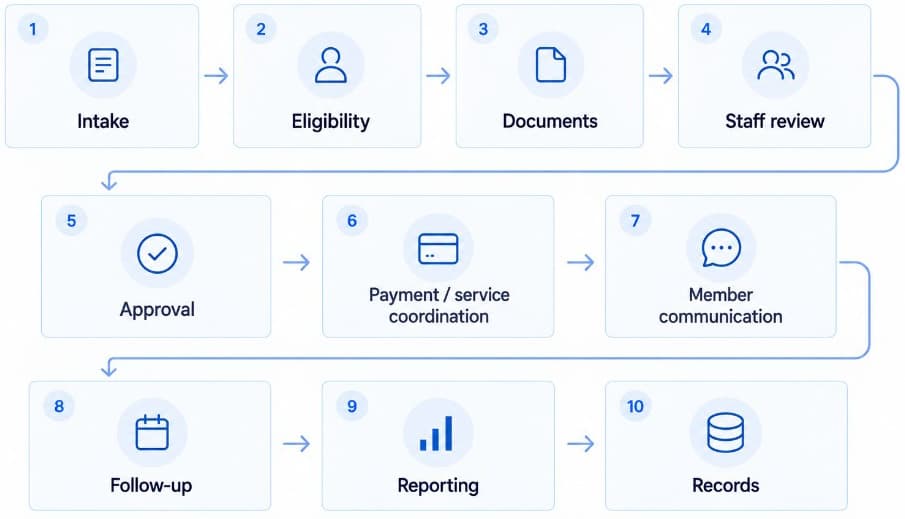
Programme delivery gets complicated quickly
A single programme can involve intake, eligibility requirements, supporting documents, staff review, approvals, member communications, payment or service coordination, follow-up, reporting, and records.
When those steps are spread across email, spreadsheets, forms, shared drives, and separate systems, it becomes harder to see where work stands and who owns the next step.
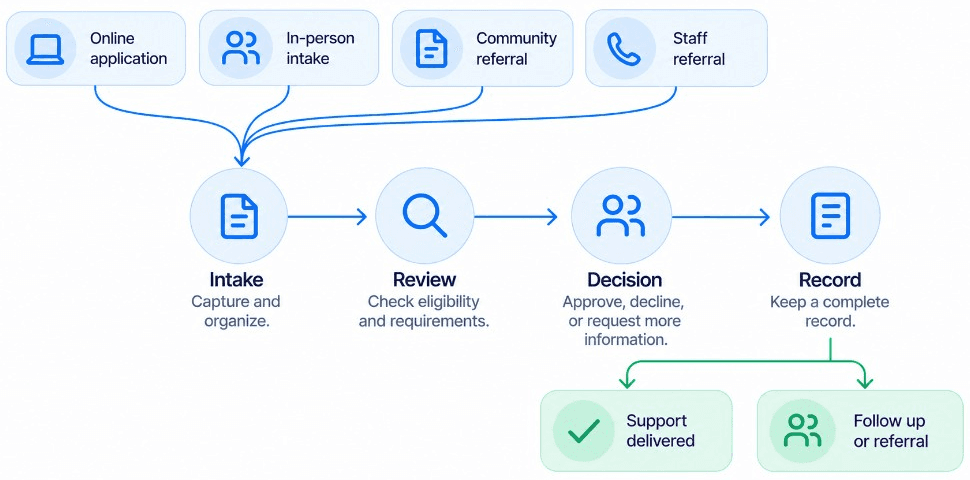
From application to clear outcome
- 01
Apply
Receive applications or requests through a controlled intake process.
- 02
Check requirements
Confirm required information and apply configured eligibility rules where appropriate.
- 03
Review
Route the application to the right staff or decision-maker.
- 04
Decide
Record the outcome, rationale, and authority behind the decision where required.
- 05
Coordinate next steps
Support communications, payment records, referrals, service delivery, or other follow-up.
- 06
Preserve the record
Keep the application, decision, supporting information, and relevant history connected.
With the operational path connected, authorized users can see where an application stands, what information is missing, who owns the next action, whether a decision has been made, and what follow-up remains.
Different programmes can work differently without operating in isolation.
A Nation can run programmes across education, training, housing, health and wellness, emergency support, recreation, culture and language, economic development, family supports, community services, and other Nation-defined priorities.
Each programme can retain its own eligibility requirements, approval pathways, documentation needs, timelines, and decision-makers while sharing common infrastructure underneath.
That shared infrastructure can support:
Member information
Relevant records support programme workflows where access is authorized.
Authority
Roles and permissions reflect who can review, approve, or access specific information.
Workflow
Applications move through defined stages with visible ownership and status.
Evidence
Supporting documentation remains connected to the application and decision.
History
Changes to programmes, roles, and rules remain understandable over time.
Accountability
It is easier to understand what happened, who was responsible, and what needs to happen next.
Example
Shared foundation, different programme paths
Programmes can retain different requirements and review paths while still operating through the same connected structure.
Education
- Intake
- Eligibility
- Review
- Decision
- Follow-up
- Record
Housing
- Intake
- Eligibility
- Review
- Decision
- Follow-up
- Record
Emergency support
- Intake
- Eligibility
- Review
- Decision
- Follow-up
- Record
Culture and language
- Intake
- Eligibility
- Review
- Decision
- Follow-up
- Record
Some programme requirements are objective. Others depend on context, discretion, professional assessment, leadership authority, or Nation-defined exceptions. RiGEL applies configured rules where they fit and keeps human review visible where judgment is required.
Member-facing does not mean RiGEL-facing
For members and families, the programme experience feels like a service from their Nation.
Nation-facing environments can reflect the Nation's branding, terminology, programme language, and communication approach while RiGEL provides the infrastructure underneath.
Preserve the reason behind the decision
A decision record can preserve the outcome, the authority behind it, the applicable programme rule or requirement, supporting evidence, rationale, relevant dates, and follow-up or appeal information.
For adverse decisions, the record supports clear communication about what was decided, why, what basis applied, and what real next step is available.
As eligibility rules, programme terms, funding availability, staff responsibilities, and approval pathways change, RiGEL preserves historical context so an earlier application can still be understood according to the requirements and authority that applied at the time.
Decision record
Decision / outcome
Authority
Applicable rule / requirement
Supporting evidence
Rationale
Relevant dates
Follow-up / appeal
Start with one programme that needs a clearer path.
RiGEL begins by understanding how the programme works today — its requirements, responsibilities, authority, records, and handoffs — then determining what the infrastructure needs to support.