

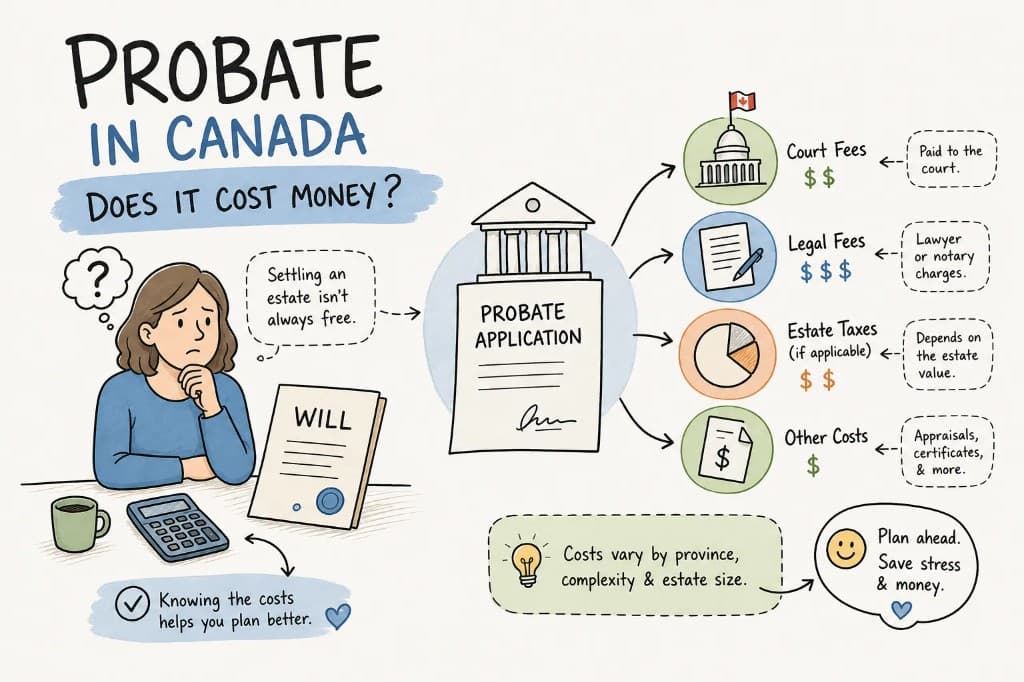
Settling an estate is not always free
Does probate cost money in Canada? Yes, and for many families, the bill is larger than expected. It arrives at the worst possible moment: when someone is grieving, and the estate is already under pressure. The exact amount depends entirely on your province, the gross value of the estate, and how your assets are structured before you die. Get those variables wrong and your beneficiaries absorb the difference.
This article is a plain-language breakdown of what probate actually costs across Canada, who pays, what drives the total bill higher than the government fee alone, and what families can do legally to reduce their exposure. Platforms like RiGEL were built specifically for this moment: helping Canadian families see their estate's financial picture clearly before they're sitting across from a lawyer with a clock ticking.
What "probate cost" actually means in Canada
Probate is not a single federal charge. It's a provincial or territorial government fee charged to validate a will and authorize the executor to act on behalf of the estate. Different provinces call it different things: Ontario uses the term "estate administration tax," while other provinces refer to it as a probate fee or court fee. The mechanism is the same regardless of the label.
What surprises most executors is that the fee is calculated on the gross value of the estate's assets, not the net value after debts. If the deceased owned a home worth $800,000 with a $400,000 mortgage, the full $800,000 counts toward the probate calculation. Paying down debt doesn't reduce your probate exposure. Only structuring assets to flow outside the estate does.
Who pays the fee and when it's due
The probate fee comes out of the estate itself, before beneficiaries receive anything. That means it directly reduces what heirs inherit. Timing is also a practical challenge: the fee is typically due at the time of application to the court, before the grant of probate is issued. The executor often needs to pull funds from the estate, or temporarily advance personal funds, to cover the fee before they have legal authority to access estate accounts. It's a logistical bind that catches many executors off guard.
What happens if an estate skips probate
Not every estate requires probate. If assets are jointly owned or flow directly to named beneficiaries, no court application is needed for those assets. But where real estate is owned solely in the deceased's name, or where financial institutions require a grant of probate before releasing funds, skipping the process simply isn't an option. Attempting to transfer assets without the proper grant exposes the executor to personal liability.
Does probate cost money the same way in every province?
No, and the difference between jurisdictions is dramatic. Canada has no uniform national fee. Each province sets its own schedule, and knowing your province's rate is the starting point for any estate cost estimate.
Provinces where probate fees are percentage-based
Ontario and British Columbia carry the highest probate exposure for most Canadian families. The table below shows the key rates for percentage-based provinces (fee schedules current as of 2026; verify current rates with your provincial court or government website):
| Province | Fee structure |
|---|---|
| Ontario | No fee on first $50,000; 1.5% on estate value above $50,000 |
| British Columbia | No fee on first $25,000; 0.6% on the next $25,000; 1.4% on everything above $50,000 |
| Nova Scotia | Sliding scale from $85.60 (estates under $10,000) to $1,002.65 on the first $100,000, plus $16.95 per $1,000 above that |
| Saskatchewan | 0.7% on total estate value |
| New Brunswick | $5 per $1,000 above $5,000 |
| Newfoundland and Labrador | $0.50 per $100 up to $100,000; $0.60 per $100 above that; plus a $200 application fee |
| Prince Edward Island | Tiered structure reaching $400 on estates above $50,000, then $4 per $1,000 above $100,000 |
Provinces with flat, capped, or effectively zero fees
Alberta caps probate at a flat $525, regardless of estate size. That's it. Manitoba abolished its value-based probate charges in 2020, and that change remains fully in effect in 2026. Quebec charges no probate fee for a notarially executed will, which is one reason notarial wills are so common in that province. Yukon charges a nominal flat fee, and the Northwest Territories and Nunavut both cap fees at roughly $425 to $435. If you live in one of these jurisdictions, probate is far less of a financial concern.
Dollar examples for $250k, $500k, and $1M estates
For readers in Ontario and BC, the numbers below make the stakes concrete. These figures use the 2026 fee schedules and are calculated on gross estate value.
| Estate value | Ontario (estate administration tax) | British Columbia (probate fee) |
|---|---|---|
| $250,000 | $3,000 | $2,950 |
| $500,000 | $6,750 | $6,450 |
| $1,000,000 | $14,250 | $13,450 |
A $1 million estate in Ontario generates over $14,000 in estate administration tax alone, and that's before a single lawyer invoice or executor compensation claim enters the picture.
Beyond the government fee: the full cost of estate administration
Probate fees get the attention, but they're only one layer of the total cost. Legal fees and executor compensation are separate charges, and together they often exceed the government fee by a wide margin.
How lawyer fees are charged for estate administration
Estate lawyers in Canada typically bill hourly for probate work. In Ontario, expect roughly $250 to $400 per hour for probate administration. British Columbia runs between $275 and $450 per hour for most estate matters, with senior lawyers billing higher. Some firms offer flat-fee packages for straightforward, uncontested estates, which can be worth asking about if the estate is simple and well-organized. The complexity of the estate drives lawyer costs more than any other single factor.
Executor compensation: the "fair and reasonable" standard
Executor fees are not fixed by province in most of Canada. In Ontario, the common benchmark follows a "5% rule": roughly 2.5% on capital receipts plus 2.5% on capital disbursements, which often works out to around 2.5% to 5% of the estate's total value. British Columbia allows a fair and reasonable allowance capped at 5% of the gross estate value, plus a 0.4% annual care-and-management fee while the estate remains open. Courts ultimately decide what is fair based on the complexity of the work, the time involved, and the skill required.
What total administration cost looks like on a mid-size estate
Run the numbers on a $600,000 estate in Ontario and the picture becomes clear. The probate fee alone is approximately $8,250. Lawyer fees for a moderately complex estate might add another $3,000 to $6,000. Executor compensation, calculated at even a conservative 3%, adds $18,000 on top. The combined total cost of administering that estate can easily reach $25,000 to $30,000 before a single dollar reaches a beneficiary. Pre-planning directly addresses this erosion. It doesn't eliminate administration costs, but it reduces the government fee and simplifies the work that drives legal and executor charges.
Assets that bypass probate entirely
Not every asset flows through the estate. Several categories of assets transfer directly to the recipient without going through the court process. Knowing which ones apply to your situation directly affects what probate costs.
Joint ownership and the right of survivorship
Property held in joint tenancy with right of survivorship passes automatically to the surviving co-owner when one owner dies. The asset never enters the estate and is therefore not included in the probate calculation. This works cleanly between spouses in most situations. The complications arise when the co-owner is an adult child or other relative, which is covered in the next section.
Named beneficiaries on insurance and registered accounts
Life insurance policies with a named beneficiary, and registered accounts including RRSPs, RRIFs, and TFSAs with valid beneficiary designations, pay directly to the named recipient and bypass the estate entirely. These are among the most powerful and underutilized tools in Canadian estate planning, largely because they require nothing more than completing a form with your financial institution.
Calculating the real dollar savings in high-fee provinces
In Ontario, every $100,000 that flows outside the estate saves approximately $1,500 in estate administration tax. A family with $400,000 in registered accounts with properly named beneficiaries avoids roughly $6,000 in probate fees in Ontario alone. How an asset is owned and titled has a direct, calculable effect on what probate costs. This is not theoretical: it shows up as real dollars that either stay in the family or go to the government.
Legal strategies to reduce your estate's probate exposure
The most effective strategies for reducing probate exposure fall into three broad categories, each with real trade-offs worth understanding before you act.
Beneficiary designations: easiest and often overlooked
Updating beneficiary designations on RRSPs, TFSAs, RRIFs, and life insurance policies is the simplest and cheapest way to move significant value outside the estate. It costs nothing beyond the time to complete the forms. The main legal risk is administrative failure: outdated designations, designations that conflict with the will, or designations that are invalid in your province can send an asset back into the estate anyway. Review your designations whenever a major life event occurs, and make sure your will and your beneficiary forms are telling the same story.
Joint tenancy: when it works and when it backfires
Joint tenancy with right of survivorship works well between spouses for primary residences and joint accounts. The complications multiply when a parent adds an adult child as a joint tenant on a property. Following the Supreme Court of Canada's decisions in Pecore and Madsen, the law presumes a resulting trust when a parent adds an adult child to title, meaning the child is presumed to hold the interest for the estate unless they can prove the parent genuinely intended a gift. Beyond the legal ambiguity, adding a child to title can trigger an immediate capital gains liability on the transferred interest, expose the asset to the child's creditors, and create family conflict after death. Joint tenancy is a useful tool in the right circumstances, but it is not a risk-free one.
Inter vivos trusts: powerful but not for every estate
A living trust, properly structured, removes assets from the estate entirely during the settlor's lifetime, which means those assets avoid probate. The trade-off is cost and complexity. Legal drafting, asset retitling, and ongoing trust administration all add up. Trusts are generally taxed at the highest marginal rate unless a specific tax rule applies, and the assets must be formally transferred into the trust to achieve any probate benefit. Inter vivos trusts make sense for larger, more complex estates where the long-term savings justify the setup costs. For most Canadian families with straightforward asset structures, updated beneficiary designations and careful titling decisions deliver most of the benefit at a fraction of the cost.
See the cost impact before you meet a lawyer
Most families don't think carefully about probate costs until an estate is already being administered. By that point, the decisions that matter most have already been made: which assets are jointly held, which accounts have named beneficiaries, how the family home is titled. Those choices, made years earlier and often without any analysis of their cost implications, determine what probate ultimately costs.
Why running the numbers early changes the conversation
The families who arrive at a lawyer's office already knowing which questions to ask get better outcomes. They've modeled the impact of naming a beneficiary versus leaving an account to flow through the estate. They understand what their current asset structure costs in probate fees and what a different structure would save. That preparation shortens the legal consultation, focuses the conversation on decisions that actually matter, and reduces the risk of paying for advice on options that were never realistic to begin with.
Comparing your options before the decisions become permanent
RiGEL's Scenario Modelling feature is designed to help Canadian families compare different planning choices and review illustrative cost impact side by side. You can see what your current structure looks like in probate terms, then compare it against an alternative where beneficiary designations are updated or joint tenancy is restructured. The platform brings together assets, beneficiaries, and planning choices in one place so the implications of each decision are visible before they become permanent. RiGEL doesn't replace your lawyer or accountant. It closes the gap between good intentions and a documented plan that actually reflects your family's situation.
Using your model as a starting point for professional advice
A clear model of your estate structure gives your legal and financial advisors something concrete to work with. Instead of spending the first hour of a consultation explaining what you own and who you want to receive it, you walk in with a working picture already organized. That changes the nature of professional advice from discovery to refinement, and it makes the time your advisors spend on your estate far more productive.
Does probate cost money in Canada? The bottom line
Yes, probate costs money in Canada, and in provinces like Ontario, British Columbia, and Nova Scotia, the fees can be substantial. A $1 million estate in Ontario pays over $14,000 in estate administration tax before any legal or executor fees are counted. The total cost of estate administration on a mid-size estate can reach $25,000 to $30,000 or more.
The good news is that probate fees are one of the most plannable costs in estate administration. Understanding your province's fee structure, reviewing which assets can bypass the probate calculation, and modeling different distribution choices before things become urgent gives your family genuine control over the outcome. The decisions that determine your probate exposure are made during your lifetime, not during administration.
If you haven't mapped out what your current estate structure actually costs, that's the place to start. RiGEL is built specifically for that work. See how RiGEL works to begin organizing your estate information and see what your family is working with, before it falls to someone else to piece together under pressure.
Frequently asked questions about probate costs in Canada
Does probate cost money in every province?
Probate involves a fee in most provinces, but the amount varies widely. Ontario and British Columbia charge percentage-based fees that can reach tens of thousands of dollars on large estates. Alberta caps its fee at $525 regardless of estate size, Manitoba abolished value-based probate fees in 2020, and Quebec charges nothing for a notarially executed will. Where you live, and how your assets are structured, determines how much probate costs.
How much does probate cost on an average Canadian estate?
That depends on your province and estate value. In Ontario, a $500,000 estate pays approximately $6,750 in estate administration tax. In British Columbia, the same estate pays roughly $6,450. In Alberta, the fee is $525 regardless of size. Add lawyer fees and executor compensation and the total administration cost on a mid-size Ontario estate commonly reaches $25,000 to $30,000. A probate fee calculator or estate planning platform like RiGEL can give you a clearer picture based on your specific numbers.
Can you reduce how much probate costs?
Yes. The most accessible strategies are updating beneficiary designations on registered accounts and insurance policies, using joint tenancy where appropriate, and for larger estates, exploring an inter vivos trust. Each approach reduces the assets that flow through the estate and are subject to the probate fee. The savings can be significant: in Ontario, moving $400,000 in registered assets to named beneficiaries avoids roughly $6,000 in estate administration tax.