

You were named executor, and there is no grace period
Someone you loved has died, and they named you executor. You are grieving, and you have just been handed a set of legal and financial executor responsibilities in Canada that most people encounter once in their lifetime, with no instruction manual and no grace period. In Ontario, the courts call you an estate trustee. In Quebec, you are a liquidator under civil law. In most other provinces, you are simply the executor. The title changes depending on where you live, but the weight of the role feels identical everywhere.
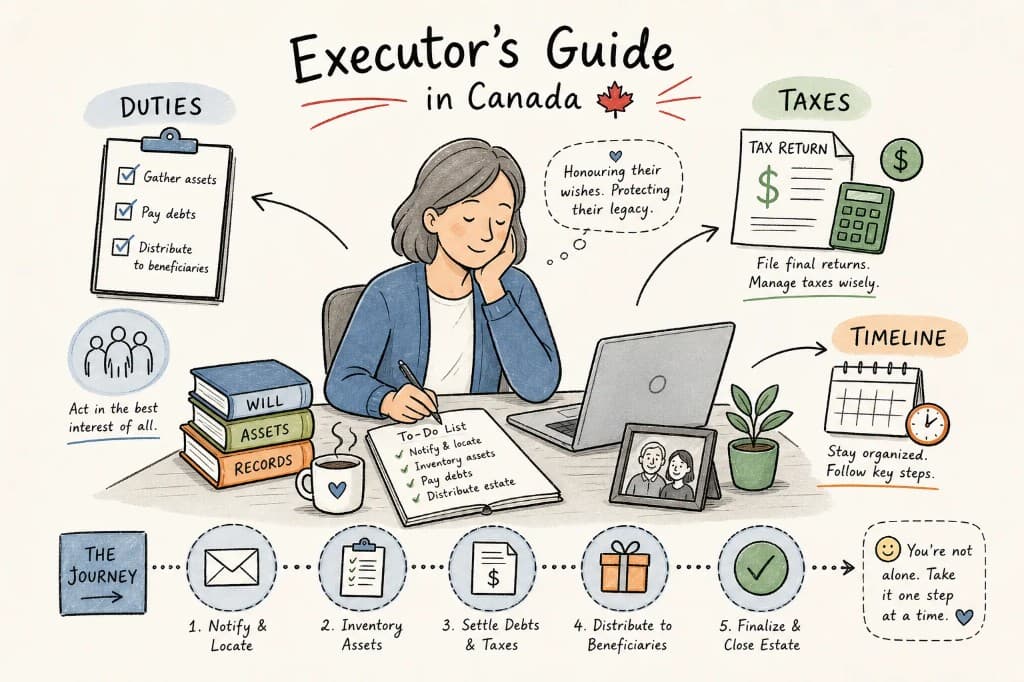
The good news is that executor responsibilities across Canada follow a predictable sequence. When you know the milestones, the documents, and the deadlines in advance, the role becomes manageable. Tools like RiGEL's Executor Handoff were built specifically for this moment: they help you start from clearer context about assets, accounts, obligations, and key contacts instead of scrambling through filing cabinets during the hardest weeks of your life. What follows is the complete picture of what the role requires, in the order it happens.
What executor responsibilities in Canada actually mean
The fiduciary duty that defines everything you do
Before you touch a single asset, understand this: you are a fiduciary. That word has real legal weight. It means you must act honestly, prudently, and always in the beneficiaries' interests. You cannot prefer yourself over others, delay distribution without good reason, or cut corners on record-keeping because it feels like extra work. Every decision you make is held to that standard.
Breaching your fiduciary duty does not just cause conflict with beneficiaries; it can expose you to personal financial liability. Courts can order an executor to repay losses caused by their own mismanagement out of their own pocket. That risk is precisely why documentation, proper sequencing, and careful judgment matter so much throughout the administration.
How the role and title differ across provinces
Ontario officially uses "estate trustee," Quebec uses "liquidator" under its civil law system, and most other provinces use "executor" or "administrator." The terminology affects the forms you file and the court process you follow, but the core duties stay consistent from coast to coast: collect the assets, protect them, pay the debts and taxes, then distribute what remains to the people named in the will.
Quebec is worth a specific note. Its civil law framework replaces the common-law probate process with a notarial verification system, and it uses the concept of a "succession" rather than an estate. If you are administering a Quebec estate, the procedural steps differ meaningfully from the rest of Canada, even though your underlying responsibilities as liquidator are functionally the same.
The estate administration timeline from first week to closing
First four weeks: securing the estate before anything else
Your first priority is stability. Register the death, locate the original will, and notify the key institutions: banks, the Canada Revenue Agency, Service Canada, and any insurance companies. Secure physical assets, cancel credit cards, redirect mail, and confirm that property insurance on any real estate remains active. None of this is glamorous work, but letting any of these slip creates problems that compound quickly.
Open an estate bank account as early as possible. Every dollar that flows in or out of the estate should move through this account, not your personal one. Commingling funds is one of the most common mistakes executors make, and it is entirely avoidable with a dedicated account opened in the estate's name from the start.
Months one through twelve: probate, taxes, and the path to distribution
If probate is required, you will typically file the application within one to three months of death. In Ontario, the certificate commonly takes six to eight weeks after filing, though busier courts in the GTA have been running twelve weeks or longer. Most other provinces follow comparable timelines, and complex files always take more time.
Research suggests most Canadian estates close somewhere between six and eighteen months after death, with straightforward files often wrapping up around the one-year mark. Estates involving real property, business interests, or unresolved CRA issues routinely stretch beyond that range. The sequence never changes: probate granted, debts paid, tax filings submitted, CRA clearance requested, final distribution made. Following that order protects you legally and keeps beneficiaries informed of where things stand.
Key documents and probate filings
The will, death certificates, and financial records
The original will must be located and kept safe from day one. Order multiple certified copies of the death certificate early; financial institutions, government agencies, and courts each require their own copy, and running short causes unnecessary delays. You will also need statements for all financial accounts, real property title documents, insurance policies, investment statements, and documentation of any outstanding loans or debts.
A complete asset inventory is not optional. It forms the foundation of the probate application, the estate accounting, and the final distribution. If the deceased used RiGEL during their lifetime, Executor Handoff can provide a purpose-limited, organized record of assets, accounts, and key contacts that would otherwise take weeks to reconstruct, letting you focus on judgment calls rather than a paper chase.
What a probate application actually requires by province
Ontario requires Form 74A (Application for a Certificate of Appointment of Estate Trustee) along with the original will, proof of death, and supporting affidavits including Form 74D, 74E, or 74F depending on the will type. Renunciations, bonds, or a motion to dispense with bond may also be required depending on the circumstances of the estate. Confirm current form numbers with the Ontario Ministry of the Attorney General, as court forms are updated periodically.
British Columbia requires a Grant of Probate application with the original will, death certificate, estate inventory, and any required renunciations or consents under BC Supreme Court probate rules. Quebec skips common-law probate entirely. A notarized will is already legally valid without court confirmation; other will types go through notarial or court verification using the death certificate and civil status documents. If you are dealing with a Quebec estate as an outsider to civil law, hire a Quebec notary early.
Tax returns and filings every executor must complete
The final T1 return and what triggers each deadline
The terminal T1 return covers the deceased's income from January 1 to the date of death. According to CRA guidance, if death occurred between January 1 and October 31, the return is due April 30 of the following year. If death occurred November 1 or later, the deadline is six months after the date of death. For self-employed individuals, slightly different rules apply depending on when in the year they passed. Check the CRA's guide for deceased persons for the specific thresholds.
Prior-year unfiled returns must also be caught up, generally by the later of their normal due date or six months after death. Executors who overlook unfiled returns from previous years discover this problem at the worst possible time, usually when CRA delays the clearance certificate. Reviewing the deceased's past five years of tax filings early in the administration prevents that surprise.
The T3 estate return and the CRA clearance certificate
If the estate earns income after death, interest, dividends, or rental income, for example, a T3 Trust Income Tax and Information Return is required. Per CRA rules, it is due 90 days after the estate's tax year-end. This filing is separate from the terminal T1 and covers a different period, so it is easy to overlook when you are focused on the initial wave of deadlines.
The CRA clearance certificate confirms that all of the estate's tax liabilities are settled. Experienced executors and estate lawyers consistently recommend waiting for this certificate before making final distributions. If you distribute assets before receiving it and the CRA later identifies an outstanding balance, you become personally liable for that amount up to the value of what you distributed. The certificate is your protection; do not skip it to save a few weeks.
Executor compensation and estate costs across provinces
How executor compensation is calculated
Executors in Canada are entitled to be compensated for their work, and the calculation varies by province. Ontario courts commonly apply a rate of 2.5% on receipts and 2.5% on disbursements, for a total of up to 5% of the estate's value. British Columbia legislation allows up to 5% of gross estate assets plus a 0.4% annual care-and-management fee for longer administrations. Alberta and Saskatchewan use a reasonableness standard that courts can review if beneficiaries dispute the amount, with common practice landing in the 3% to 5% range.
Quebec is the clear exception: the liquidator is generally not entitled to any compensation unless the will explicitly authorizes it or all heirs agree. If you are a Quebec liquidator and compensation matters to you, confirm what the will says before you begin. Discovering that detail at the end of a year of work is a frustrating outcome, one that a quick review of the will upfront prevents entirely.
Probate fees, professional costs, and what gets paid from the estate
Executor compensation and probate fees are two separate things. Probate fees are government charges to validate the will and authorize your authority as executor; they are calculated on the estate's value and vary significantly by province. Both come out of the estate, but they are distinct line items with different purposes and different recipients.
Beyond those two costs, the estate typically also covers legal fees, accounting fees, property appraisals, ongoing insurance and maintenance for real estate held during administration, and the cost of death certificates ordered for financial institutions. All of these expenses are paid from the estate before any final distribution reaches the beneficiaries. Keeping every receipt, for every expense, is non-negotiable.
Common mistakes that cost executors time, money, and liability
Where executors run into serious trouble
Distributing assets before debts and taxes are fully settled is the single most common and most costly mistake an executor makes. The moment you pay out a beneficiary while an outstanding liability exists, you become personally responsible for the shortfall. The estate's obligations do not disappear because you thought the accounting looked clean.
Missing tax deadlines, failing to notify creditors properly, commingling estate and personal funds, and not keeping receipts for every expense are other frequent missteps. Executors managing complex estates without professional help, those involving real property, business interests, or cross-border assets, often create delays that stretch well past the one-year mark. That delay alone can trigger formal beneficiary complaints or court involvement, adding cost and stress to an already difficult process.
Starting from clarity instead of chaos
Most executor mistakes trace back to one root cause: walking into the role with no information. No asset list, no account numbers, no summary of what the deceased owned or owed, no record of their wishes. The executor spends the first weeks just trying to understand what exists before they can do anything constructive.
RiGEL's Executor Handoff addresses exactly this gap. It helps the person who may eventually need to act start from purpose-limited, plain-language context: assets, accounts, obligations, and key contacts, organized when they need it most. When the paperwork is already structured, the executor can focus on judgment calls and proper sequencing rather than a frantic search for documents. If you are reading this as the will-maker rather than the executor, the most valuable thing you can do is organize your estate now, before a crisis forces the conversation. Your executor will carry that gift forward at exactly the moment it matters most.
Knowing the path makes the role manageable
Executor responsibilities in Canada are demanding, but they are not unknowable. The sequence is consistent: understand your fiduciary duty, secure the estate in the first weeks, apply for probate where required, complete the tax filings in order, obtain CRA clearance before distributing anything, manage costs carefully, and document everything. Following that path keeps you on the right side of both the law and the people you are serving.
The biggest risks, personal liability and beneficiary disputes, almost always stem from rushing the sequence or starting with incomplete information. Neither of those problems is inevitable. With the right preparation in place before a death occurs, the executor inherits a clearer picture instead of a puzzle. That is the difference between an estate that closes in twelve months and one that drags on for years.
If you are currently in the role and feeling overwhelmed, start with the timeline and work forward from today. If you are the person whose estate will one day need administering, start organizing now. See how RiGEL works. The best time to build that record is well before anyone needs it.